NVIDIA’s NemoClaw represents a significant step forward in making autonomous AI agents enterprise-ready by addressing the critical security gap that has plagued the viral OpenClaw platform. With one-command deployment, built-in NVIDIA Nemotron model support, and comprehensive security guardrails, it offers enterprises a safer path to AI agent adoption.
Best For: Enterprise software companies, organizations with sensitive data requirements, and teams already invested in NVIDIA’s ecosystem.
What is NemoClaw?
NemoClaw is NVIDIA’s newly announced open-source AI agent platform, unveiled at the GPU Technology Conference (GTC) 2026. Built upon the foundation of the wildly popular OpenClaw framework, NemoClaw represents NVIDIA’s strategic move to address the enterprise security concerns that have historically limited AI agent adoption in corporate environments.
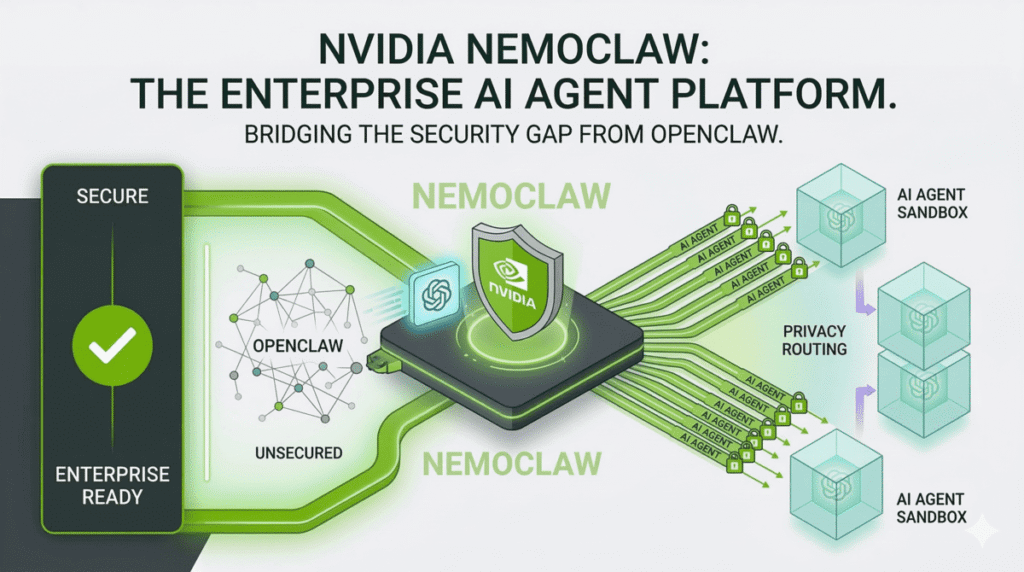
At its core, NemoClaw is an infrastructure layer that adds privacy and security guardrails to OpenClaw’s agent capabilities. The platform enables users to install NVIDIA Nemotron models and the newly announced NVIDIA OpenShell runtime platform in a single command, making it significantly easier to deploy secure, autonomous AI agents.
The timing of this announcement is particularly significant. The AI agent market has exploded, with OpenClaw becoming one of the most viral open-source projects. However, enterprises have remained cautious due to valid security and privacy concerns. NVIDIA’s NemoClaw directly targets these apprehensions.
Background: The Rise of OpenClaw
To understand NemoClaw’s significance, we must first examine the phenomenon of OpenClaw. Launched as an open-source autonomous AI agent framework, OpenClaw quickly amassing over 200,000 GitHub stars. It functions as a self-hosted personal AI assistant platform accessible through multiple channels including WhatsApp, Telegram, and Discord.
Its appeal lies in its ability to run autonomous agents that can perform complex tasks—from scheduling appointments to managing documents—without constant human oversight. However, OpenClaw’s rapid adoption revealed a critical problem: security.
OpenClaw’s architecture introduced vulnerabilities like unauthorized data access and insufficient access controls. This created the exact gap that NVIDIA has now moved to fill with NemoClaw.
Key Features and Capabilities
NemoClaw introduces several critical features designed to make AI agents enterprise-ready:
1. Single-Command Deployment
One of NemoClaw’s most compelling features is its streamlined deployment process. With a single command, users can install NVIDIA Nemotron models and the OpenShell runtime platform. The platform is designed to be hardware-agnostic, meaning it doesn’t require NVIDIA-specific hardware to operate, though integration with NVIDIA GPUs provides performance benefits.
2. Enterprise-Grade Security Guardrails
Security is where NemoClaw truly differentiates itself. The platform introduces several critical security mechanisms:
- Sandboxing: Agents operate in isolated environments.
- Least-Privilege Access Controls: Granular permission systems ensure agents only access necessary resources.
- Privacy Routing: Intelligent routing ensures sensitive data stays within designated boundaries.
3. Local Model Deployment
For organizations with strict data sovereignty requirements, NemoClaw supports running open models entirely locally. This eliminates the need to send sensitive data to external cloud services, addressing one of the primary concerns that has slowed enterprise AI adoption.
NemoClaw vs. OpenClaw: A Detailed Comparison
| Feature | OpenClaw | NemoClaw |
| Security Controls | Basic; requires custom implementation | Built-in sandboxing, access controls, privacy routing |
| Enterprise Readiness | Limited; primarily for personal use | Enterprise-grade with compliance features |
| Model Support | Open models; manual configuration | Native Nemotron integration; one-command setup |
| Data Privacy | User-implemented | Policy-based privacy routing; local model support |
Strengths and Limitations
Strengths
- Addresses Critical Security Gap: Provides built-in sandboxing and access controls.
- Open-Source Philosophy: Despite NVIDIA backing, the platform remains open-source, allowing for auditability.
- Local Deployment Options: Addresses acute data sovereignty concerns in regulated industries.
Weaknesses and Limitations
- Limited Production Track Record (High Severity): As a newly announced platform, NemoClaw lacks battle-tested reliability.
- Dependency on OpenClaw Evolution (Medium Severity): As an enhancement layer, architectural shifts in OpenClaw could create compatibility challenges.
Counterarguments and Considerations
Counterargument 1: “Organizations can implement their own security on top of OpenClaw”
While technically true, this underestimates the complexity required to build enterprise-grade controls. Custom implementations are more likely to contain vulnerabilities than a platform designed with security in mind.
Counterargument 2: “NVIDIA’s involvement creates vendor lock-in risk”
NemoClaw is open-source and hardware-agnostic, reducing this risk. For most enterprises, the benefits of NVIDIA’s ecosystem integration outweigh the minimal lock-in risks.
Recommendations and Future Outlook
Best Fit Organizations
- Enterprise software companies looking to deploy agents at scale.
- Organizations in regulated industries (healthcare, finance, government).
- Teams seeking to accelerate AI agent adoption without building security from scratch.
Getting Started Guide
- Start with a pilot project in a non-critical environment.
- Review the open-source codebase to understand security implementations.
- Engage with the community through GitHub and NVIDIA forums.
Future Outlook
The open-source nature of NemoClaw suggests NVIDIA’s strategy extends beyond direct platform monetization. By establishing NemoClaw as a standard for secure AI agent deployment, NVIDIA strengthens its position as the infrastructure provider of choice for enterprise AI.