The dawn of AI coworkers is upon us. Picture this: You sit down at your desk on a Monday morning, coffee steaming beside you. Instead of drowning in unread emails and scattered files, you simply describe what needs to be done. “Organize my project folders, draft responses to these client emails, and research the latest market trends,” you say. Then, you lean back and watch as an invisible digital colleague takes over, executing each task with precision while you focus on the work that truly matters.
This isn’t science fiction anymore—it’s the reality that AI agents are bringing to knowledge workers worldwide. In this rapidly evolving landscape, two platforms have emerged as frontrunners in the race to create the ultimate AI coworker: Claude Cowork by Anthropic and OpenClaw, the open-source contender created by Peter Steinberger.
Both promise to revolutionize how we work, but they represent fundamentally different philosophies about what an AI assistant should be and who should control it. The choice in the Claude Cowork vs OpenClaw debate echoes a broader technology argument: the convenience of proprietary solutions versus the freedom of open-source alternatives.
Claude Cowork offers a meticulously crafted, enterprise-ready experience backed by one of AI’s most respected companies. OpenClaw champions user sovereignty, privacy, and community-driven innovation. Understanding these differences is essential for anyone looking to harness AI’s transformative power in their daily workflow.
Understanding the Contenders: Origins and Evolution
Claude Cowork: Anthropic’s Enterprise-Grade Vision
Claude Cowork emerged from Anthropic’s laboratories as the consumer-friendly face of Claude Code, the company’s powerful terminal-based AI agent. While Claude Code required technical expertise, Cowork democratized access to these “agentic capabilities”—the ability to autonomously execute multi-step processes—bringing them to the Claude Desktop application where anyone could harness them through natural language.
Unlike traditional chatbots that respond to individual queries, Claude Cowork can work through complex sequences: reading local files, organizing information, creating documents, and automating browser-based tasks.
Recent developments have dramatically expanded Cowork’s enterprise appeal. In February 2026, Anthropic announced a suite of 13 new enterprise plugins, integrating the platform with Google Workspace, DocuSign, and WordPress. The message is clear: Claude Cowork is becoming an enterprise productivity platform designed to scale across organizations.
OpenClaw: The Open-Source Rebellion
OpenClaw’s story reads like a Silicon Valley fable. Created by developer Peter Steinberger, it began as a personal experiment in AI-powered automation. The concept was radical in its simplicity: instead of creating another proprietary platform, why not build an autonomous agent that lives in the messaging apps users already use? WhatsApp, Telegram, Slack, Discord, Signal—OpenClaw meets users where they are.
The platform’s open-source nature became its greatest strength. By making the code freely available on GitHub, Steinberger invited a global community to extend and customize the assistant. In a dramatic February 2026 announcement, Steinberger revealed OpenClaw was transitioning into an independent open-source foundation supported by—but not controlled by—OpenAI. This move ensures long-term sustainability while preserving its community-driven ethos, offering genuine ownership of your digital assistant.
Head-to-Head: Feature Comparison and Analysis
User Interface and Accessibility
The primary difference lies in interaction. Claude Cowork operates through the polished Claude Desktop application. Users interact through plain English commands in an intuitive, guided environment. Cowork operates within a controlled sandbox that Anthropic has engineered for safety.
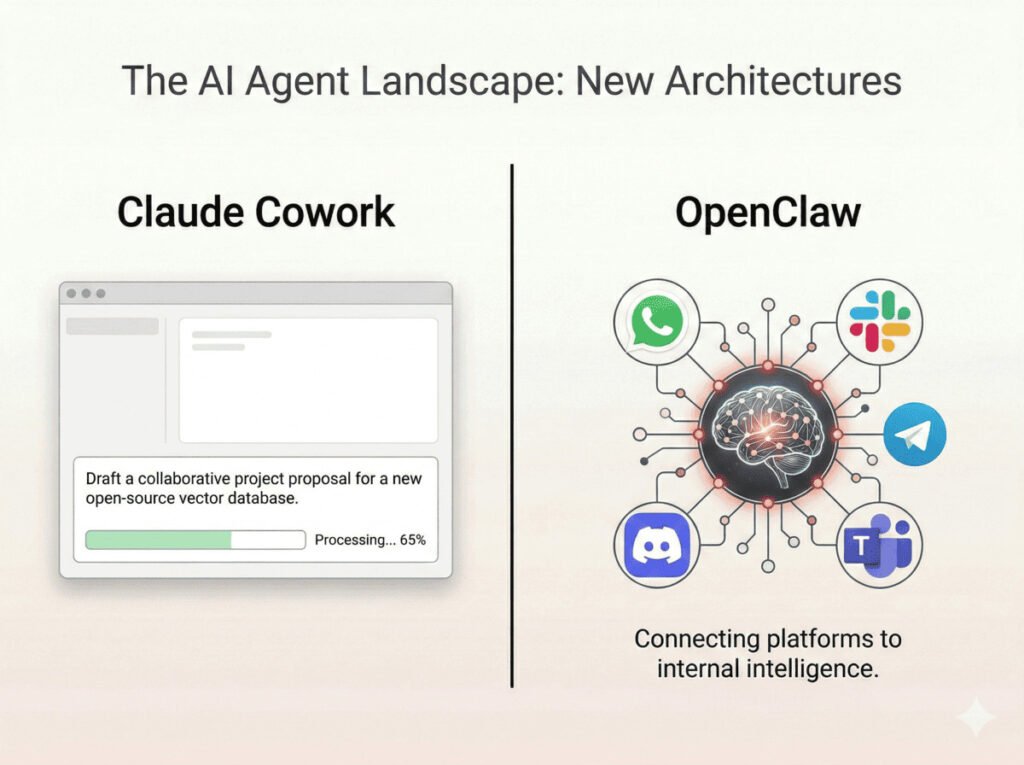
OpenClaw takes a “come to the user” approach, operating within your existing communication channels like Slack or WhatsApp. This eliminates adoption barriers but comes with a steeper learning curve; setting up OpenClaw requires technical configuration, such as installing gateway software and connecting APIs.
Feature Comparison at a Glance
Below is a summary of the key differences in the Claude Cowork vs OpenClaw matchup.
| Feature | Claude Cowork | OpenClaw |
| Primary Interface | Claude Desktop App | WhatsApp, Telegram, Slack, 20+ channels |
| Deployment Model | Cloud-based (Anthropic servers) | Self-hosted on your infrastructure |
| Pricing | Pro: $20/mo | Max: $100-200/mo | Free (open-source), self-hosting/API costs apply |
| Data Privacy | Anthropic’s cloud with enterprise controls | 100% private, data never leaves your servers |
| LLM Support | Claude models only | Anthropic, OpenAI, local models |
| Enterprise Integrations | Google Workspace, DocuSign, WordPress | Community plugins, custom integrations |
| Setup Complexity | Minimal, guided onboarding | Technical setup required |
Pricing and Data Sovereignty
Claude Cowork is a paid subscription service. The Pro plan ($20/month) provides full access, while Max tiers ($100-$200/month) offer higher usage limits for power users.
OpenClaw is free to download, but users bear the costs of hosting and API keys for underlying LLM services (like GPT or Claude). While potentially cheaper, it requires an honest accounting of hidden infrastructure costs.
Crucially, Claude Cowork operates on Anthropic’s cloud infrastructure. While secure, users are trusting a third party. OpenClaw offers complete data sovereignty—your data never leaves your infrastructure, a vital feature for regulated industries or privacy-conscious individuals.
Choosing Your AI Partner: Use Case Scenarios
When Claude Cowork Shines
Claude Cowork is the ideal choice prioritizing convenience, polish, and enterprise readiness over absolute control.
- Enterprise Deployments: Organizations needing managed solutions with clear accountability, audit trails, and vendor support.
- Non-Technical Users: Professionals—executives, marketers, HR specialists—who benefit from guided onboarding and zero coding requirements.
- Google Workspace Users: Those whose professional life revolves around Gmail and Drive will find the native integrations seamless.
When OpenClaw Excels
OpenClaw is the compelling choice for users who value control, privacy, and customization enough to invest in technical setup.
- Privacy-Critical Applications: Healthcare, legal, or financial firms bound by strict regulatory requirements needing complete data sovereignty.
- Mobile-First Workers: Consultants or sales reps who live in WhatsApp or Telegram and need AI assistance without new apps.
- Developers and Technical Teams: Organizations with the talent to customize behavior, use local models, and integrate deep into internal systems.
The Verdict: Two Paths to the Same Future
The comparison between Claude Cowork and OpenClaw reveals less about which platform is “better” and more about what kind of AI future you want to build.
Claude Cowork represents the path of convenience—a polished, supported platform that trades some freedom for substantial ease of use. OpenClaw represents the path of sovereignty—a flexible, transparent foundation that demands more from users but offers unmatched control in return.
For many, the decision framework is straightforward: If you want to get started quickly with enterprise-grade tools, choose Cowork. If you require absolute data privacy or technical customization, choose OpenClaw.
What is clear is that the era of AI coworkers has arrived. The platforms we choose today will shape the digital world we inhabit tomorrow.