Understanding what is OpenClaw is essential for anyone interested in the future of personal AI. Lets take a Deep Dive into the Viral Open-Source AI Agent
The Lobster That Changed Everything
In the vast ocean of artificial intelligence tools, a peculiar creature emerged in late 2025—a lobster named Claw, which would evolve into something far greater than its creator ever imagined. What started as a weekend project by Peter Steinberger, a developer simply looking to relay WhatsApp messages through an AI interface, has transformed into one of the most remarkable open-source phenomena the tech world has witnessed in recent years. With over 100,000 GitHub stars amassed in mere weeks and 2 million visitors flooding the project’s pages within a single week, OpenClaw didn’t just arrive—it crashed through the doors of the AI establishment with the force of a digital tidal wave.
This is not merely another AI chatbot or yet another wrapper around large language models. OpenClaw represents a fundamental shift in how we think about personal AI assistants—a rebellion against the SaaS model where your data lives on someone else’s servers, where your conversations become training fodder, where your digital life is monetized by corporations you’ve never met. It is, at its core, a declaration of digital independence: your assistant, running on your machine, following your rules, answerable only to you.
The Origin Story: From Clawd to OpenClaw
A Tale of Three Names
Every great story has its twists, and OpenClaw’s journey through identity is no exception. The project was born in November 2025 under the name “Clawd”—a clever play on “Claude,” the AI model from Anthropic, combined with the imagery of a claw. The lobster mascot was chosen not just for its claw, but for what lobsters represent: creatures that grow by shedding their shells, becoming something bigger and stronger with each molt. It was poetic, fitting, and—as it turned out—legally problematic.
Anthropic’s legal team, quite reasonably, asked the team to reconsider the name. And so, in a chaotic 5 AM Discord brainstorming session with the community, “Moltbot” was born. The name carried beautiful symbolism—molting represents growth, transformation, becoming something more. But as NetworkChuck and others pointed out, it didn’t quite roll off the tongue. The community struggled with pronunciation, and the name never quite captured the imagination the way the project deserved.
On January 29, 2026, the project found its permanent identity: OpenClaw. This time, proper homework was done—trademark searches came back clear, domains were secured, migration code was written. The name perfectly captures the project’s essence: “Open” signals its open-source, community-driven nature, while “Claw” maintains the beloved lobster heritage. As Peter Steinberger wrote in his announcement, “The lobster has molted into its final form.”
What Exactly is OpenClaw?
Moreover, what is OpenClaw tailored to achieve? It provides users with unprecedented control over their personal AI.
To delve deeper into what is OpenClaw, we need to explore its unique features.
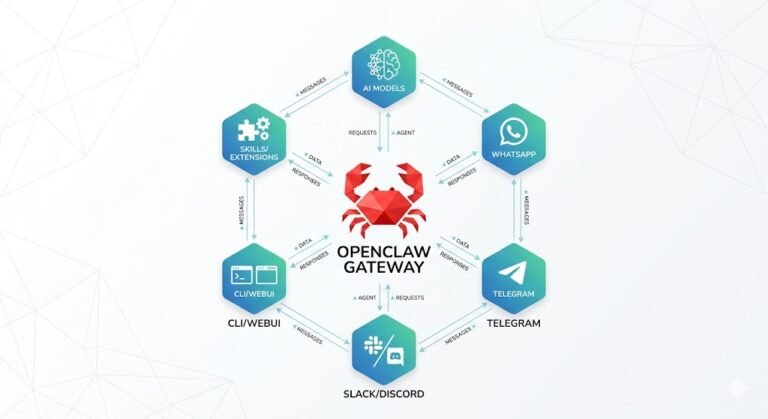
At its essence, OpenClaw is an open agent platform that runs on your machine and works from the chat apps you already use. WhatsApp, Telegram, Discord, Slack, Microsoft Teams, Twitch, Google Chat—wherever your conversations happen, OpenClaw follows. It’s not asking you to adopt a new interface or learn a new system; instead, it meets you where you are, integrating seamlessly into your existing digital workflow.
The philosophy is captured in a simple mantra: “Your assistant. Your machine. Your rules.” Unlike SaaS assistants where your data resides on distant servers, OpenClaw runs where you choose—your laptop, your homelab, your VPS. Your infrastructure. Your keys. Your data. This isn’t just about privacy (though that’s certainly a factor); it’s about ownership and control. When OpenClaw executes a command, you know exactly where it’s happening. When it accesses your files, you decide what it can see. When it browses the web on your behalf, you’re in the driver’s seat.
Under the Hood: Architecture and Capabilities
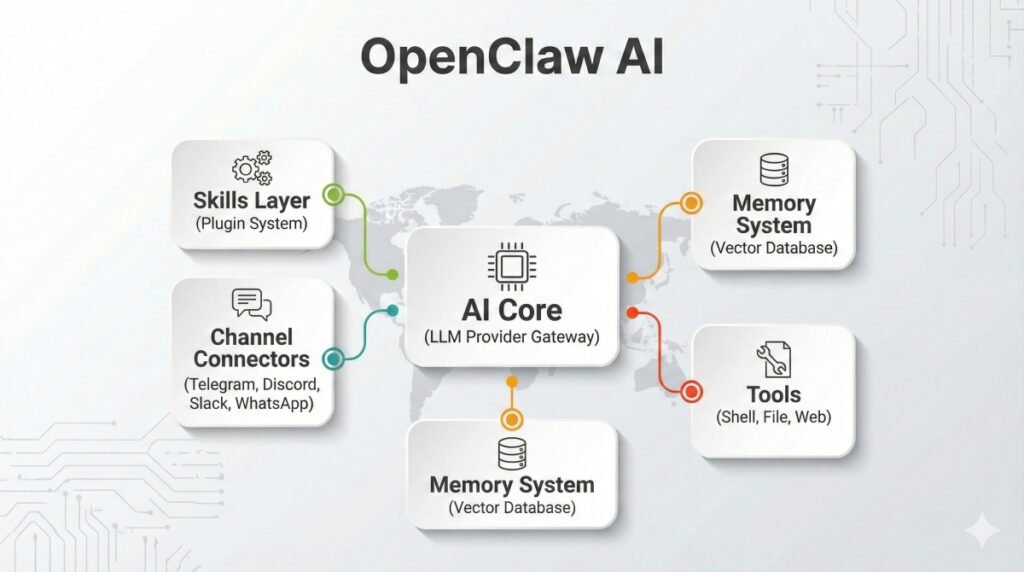
The Engine Room
Thus, for those wondering what is OpenClaw, it’s not just another assistant; it’s a revolution.
OpenClaw’s architecture is designed with extensibility at its core. The system is built around several key components that work in harmony to deliver its impressive capabilities. At the heart lies the reasoning engine, powered by strong foundation models such as Claude Opus 4.6 or various open-source alternatives. This engine doesn’t just process text—it reasons, plans, and executes complex multi-step operations.
The platform’s extensibility comes through its plugin system. Plugins extend OpenClaw in four main ways: Channel plugins add support for additional messaging platforms; Tool plugins provide new capabilities like file operations or web browsing; Skill plugins enable specialized tasks and integrations with external services; and Provider plugins allow connection to different AI model backends. This modular approach means that OpenClaw can grow and adapt without requiring changes to its core code.
Key Capabilities
What sets OpenClaw apart from other AI assistants is its level of system integration. It doesn’t just chat—it acts. With full system access, OpenClaw can run scripts, manage files, execute terminal commands, and interact with your operating system at a deep level. It can open a web browser, navigate to websites, extract information, and return results. It can work with your documents, organize your files, and automate repetitive tasks that would otherwise consume hours of your time.
The platform supports an impressive array of AI models, giving users flexibility in their choice of underlying intelligence:
Claude Sonnet 4.5 and Claude Opus 4.6 for state-of-the-art reasoning capabilities
KIMI K2.5 and Xiaomi MiMo-V2-Flash for diverse model options
Open-source alternatives for those who prefer community-developed models
Support for custom model deployments and local inference
The Skills Ecosystem
One of OpenClaw’s most powerful features is its skills system. Skills extend the platform’s capabilities, allowing it to interact with external services, automate workflows, and perform specialized tasks. The community has developed an impressive ecosystem of skills, available through ClawHub (OpenClaw’s public skills registry). These skills range from productivity tools to developer utilities, from creative applications to business automation.
The extensibility of the skills system means that OpenClaw can be customized for virtually any use case. Developers can create skills that integrate with their favorite tools and services, while non-technical users can benefit from skills shared by the community. This collaborative approach has been key to OpenClaw’s rapid growth and adoption.
Real-World Applications
So, if you ask what is OpenClaw, the answer lies in its adaptability and user empowerment.
For Developers
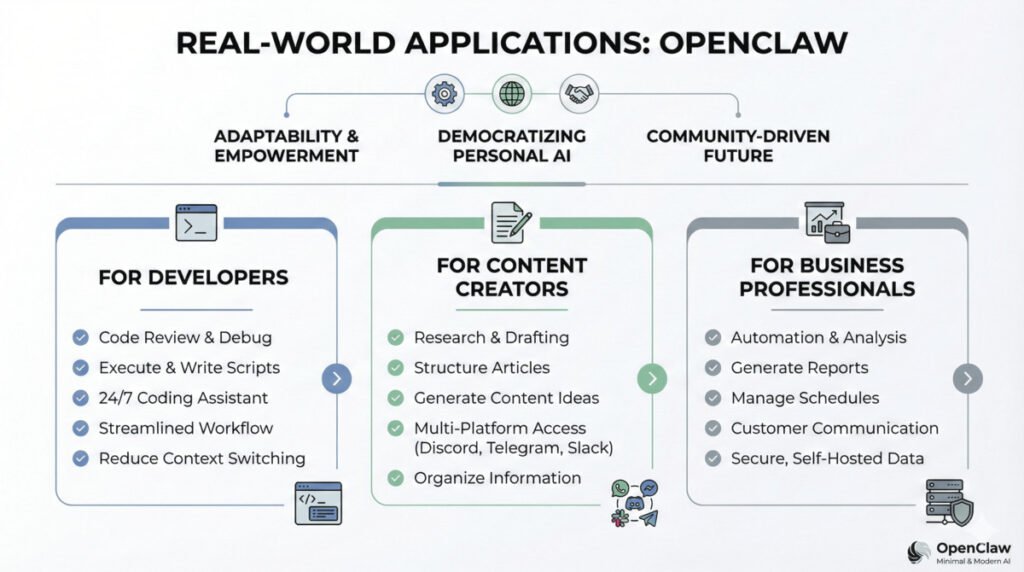
Developers have found OpenClaw to be an invaluable companion in their workflow. The assistant can review pull requests, write and execute code, debug issues, and even help with documentation. It’s like having a senior developer available 24/7, ready to assist with any coding challenge. The ability to run scripts and interact with development tools directly from chat interfaces has streamlined many development workflows, reducing context switching and increasing productivity.
For Content Creators
Content creators leverage OpenClaw for research, drafting, and organization. The assistant can search the web, compile information, help structure articles, and even generate content ideas. With the ability to work across multiple messaging platforms, creators can access their AI assistant from wherever they’re most comfortable working—whether that’s a dedicated Discord server, a private Telegram chat, or a Slack workspace.
For Business Professionals
Business professionals use OpenClaw for automation, analysis, and communication. The platform can generate reports, analyze data, manage schedules, and assist with customer communications. The self-hosted nature of OpenClaw makes it particularly attractive for businesses with strict data governance requirements—sensitive information never leaves the organization’s infrastructure.
The Other Side: Challenges and Considerations
Security Concerns
With great power comes great responsibility, and OpenClaw’s extensive system access raises legitimate security considerations. The project has faced scrutiny from security researchers, and the team has responded with remarkable diligence. In a recent release, they shipped 34 security-related commits to harden the codebase, released machine-checkable security models, and published comprehensive security best practices documentation.
The elephant in the room is prompt injection—an industry-wide unsolved problem that affects all AI agents. Malicious prompts embedded in documents, websites, or messages could potentially manipulate the assistant into unintended actions. The OpenClaw team has been transparent about this risk, recommending the use of strong models and careful configuration. Tools like SecureClaw, a dual-stack open-source security plugin, have been developed to add additional layers of protection.
As we continue to explore what is OpenClaw, we uncover its potential to reshape the digital landscape.
Technical Complexity
This is precisely why what is OpenClaw is a question that resonates with many in the tech community. With every update, OpenClaw becomes clearer, showcasing its remarkable evolution.
While OpenClaw can be installed with a simple curl command (“curl -fsSL https://openclaw.ai/install.sh | bash”), configuring and maintaining the system requires some technical knowledge. Users need to understand API keys, model selection, network configuration, and security settings. For non-technical users, this learning curve can be steep, though the community has developed numerous tutorials and guides to ease the process.
Resource Requirements
Running a capable AI assistant locally or on a VPS requires computational resources. While OpenClaw can be configured to use external APIs (reducing local compute requirements), those come with their own costs. Users running everything locally need capable hardware, especially if they want to use open-source models. This creates a barrier for users with limited resources or older hardware.
The Claw Crew: A Community Phenomenon
Perhaps the most remarkable aspect of OpenClaw’s story is its community. Dubbed the “Claw Crew,” the community of contributors, users, and enthusiasts has grown at an astonishing pace. Discord servers buzz with activity, GitHub issues multiply by the hundreds, and pull requests arrive faster than the core team can review them. This organic growth has created both opportunities and challenges—the project has had to rapidly develop processes to handle the “insane influx of PRs and Issues,” as Peter Steinberger described it.
The community’s contributions extend beyond code. Documentation, tutorials, translations, and even creative projects like the “AI by Hand” illustrated guide have emerged from this vibrant ecosystem. The project’s mascot—the lobster—has become a symbol of transformation and growth, appearing in countless community creations and cementing the project’s unique identity in the often-sterile world of developer tools.
The Road Ahead
Looking forward, OpenClaw’s trajectory seems aimed at three key areas: security, reliability, and accessibility. Security remains the top priority, with ongoing work to harden the platform and develop better defenses against prompt injection and other attack vectors. Gateway reliability is another focus—ensuring that the connections between OpenClaw and various AI providers remain stable and performant. And accessibility means not just ease of use, but also support for more models, more platforms, and more languages.
The project is also tackling the challenge of sustainability. With over 18 repositories under the OpenClaw organization on GitHub, maintaining and developing the platform requires significant resources. Peter Steinberger has spoken openly about the need to “figure out how to pay maintainers properly—full-time if possible.” Community sponsorship through GitHub Sponsors and contributions have helped, but building a sustainable open-source project at this scale remains an ongoing challenge.
A New Paradigm
OpenClaw represents something larger than itself—a shift in how we think about AI assistants. It challenges the dominant paradigm of cloud-hosted, data-harvesting AI services and offers an alternative: personal AI that you control, that runs on your hardware, that respects your privacy. It’s a vision of AI as a tool for empowerment rather than extraction.
The lobster has indeed molted into its final form, but that doesn’t mean the transformation is complete. Like its crustacean namesake, OpenClaw will continue to grow, shedding old limitations and developing new capabilities. The community that has formed around it—the Claw Crew—ensures that this evolution will be shaped by many hands, many voices, many perspectives. In a tech landscape often dominated by corporate giants and closed systems, OpenClaw stands as a testament to what’s possible when passionate people come together around a shared vision of openness and empowerment.
And yes, the mascot is still a lobster. Some things are sacred. 🦡